
RDS 2025: Robotic Hand Control System
Published:
📍 Institution: Northwestern University — Robotics Design Studio
🛠️ Role: Software Team (Kinematics & Control)
📅 Duration: Jan 2025 – Jun 2025
Overview
RDS 2025 is a fully integrated robotic hand system composed of a 2-DOF wrist, 4-DOF dexterous finger, and 1-DOF power finger. The system employs Series Elastic Actuators (SEA) and tendon-driven actuation, managed through a multi-layered microcontroller architecture over CAN bus.
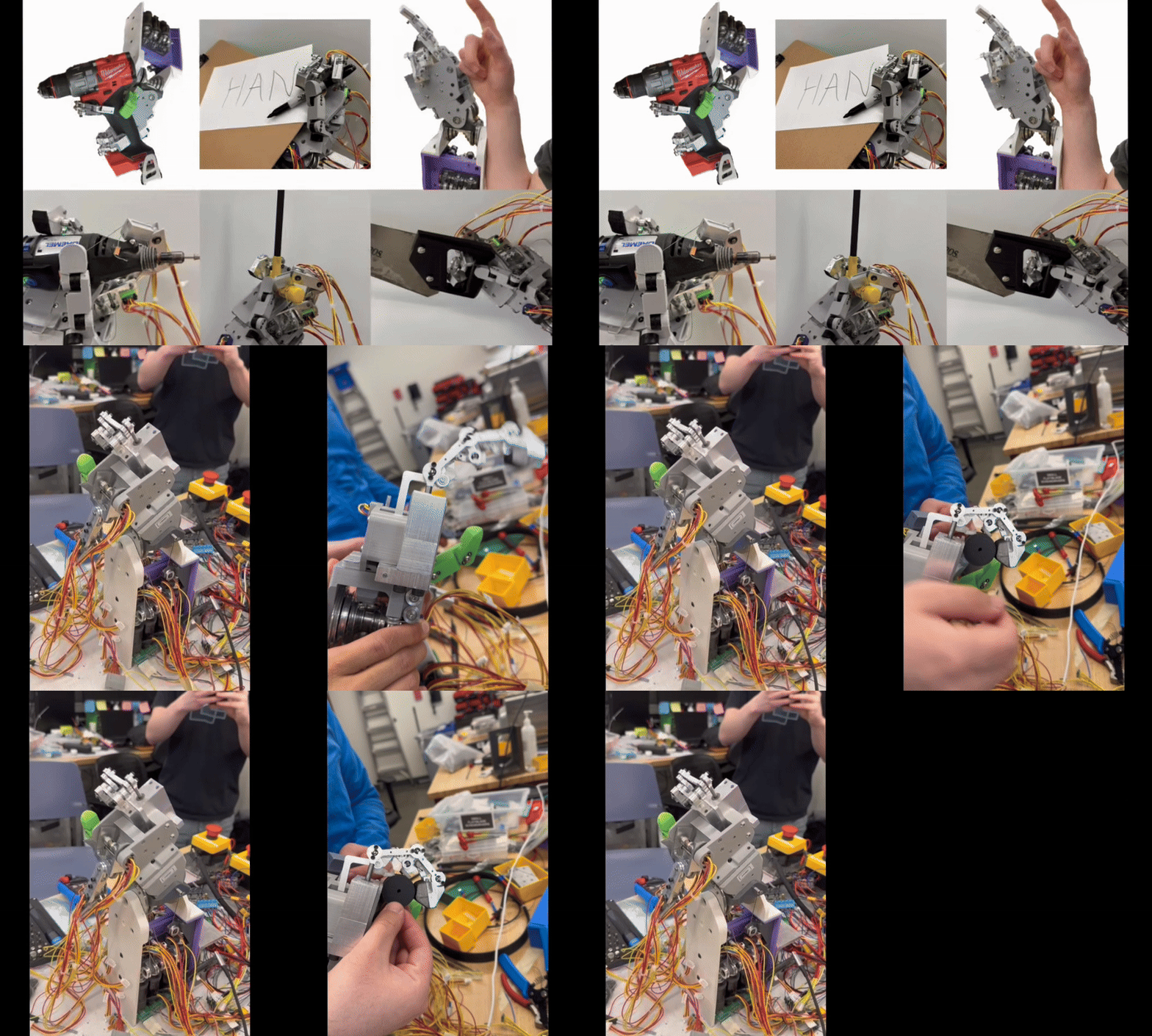
I contributed to the software team, specifically help with:
- Joint-space and tendon-space kinematics
- Torque mapping and null-space control
- Low-/high-level PID control pipelines
System Contributions
🧠 Kinematics & Control Logic
- Developed tendon-to-joint velocity mapping via a Jacobian matrix.
- Supported null-space torque for tendon pretension and stability.
- Verified real-time performance with <100 ms control latency.
💡 SEA Force Modeling
- Calibrated force-deflection mappings for all linear and nonlinear SEAs.
- Integrated force curves into real-time force control feedback loops.
⚙️ Distributed Microcontroller Control
- Built state-machine and coordination logic for high-level controller (Teensy 4.1).
- Integrated joint-space PD control with SEA-based torque outputs to low-level MCUs.
📡 CAN Bus Communication
- Developed and debugged multi-node CAN protocols using
rds25-comms. - Achieved reliable inter-device synchronization between wrist, dexterous finger, power finger, and palm controller.
🖥️ GUI & Debugging
- Supported Python-based Tkinter GUI with real-time plotting, system configuration, and diagnostic tools.
- Enabled position command streaming, error recovery, and calibration via interactive interface.
Results & Impact
- ✅ Real-time SEA-based force control with ±0.1N accuracy.
- ✅ Full hand system tested with all DOFs under unified kinematic and communication framework.
- ✅ Modular software design enabled incremental hardware bring-up and multi-phase integration.